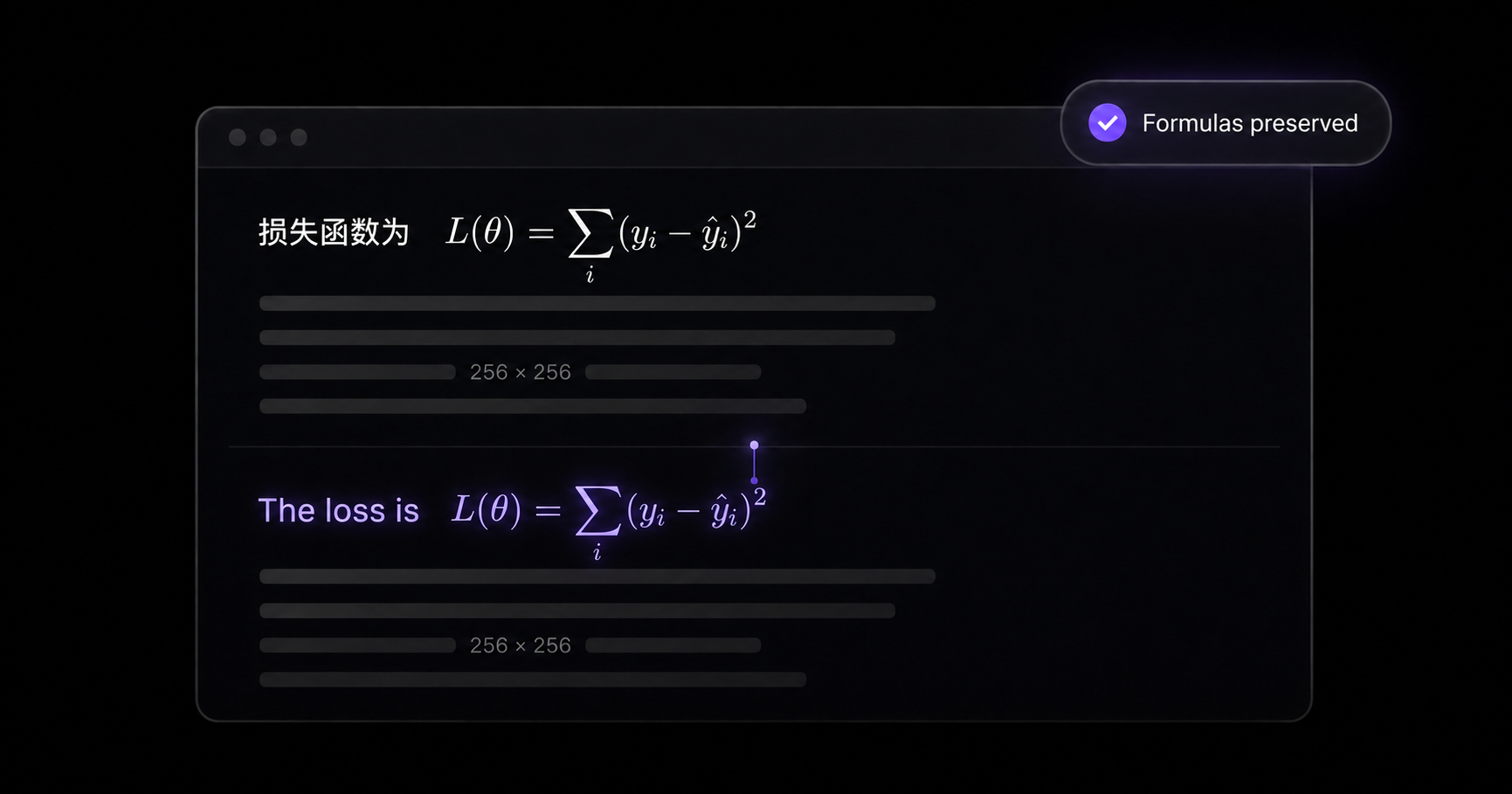
You reach a crucial explanation in a paper. The words are translated, but the formulas inside the sentence have disappeared.
The author distinguishes instantaneous velocity v from average velocity u, but the translation leaves out both variables. An experimental setting of 256 × 256 becomes 256256. You return to the original, reconstruct the missing notation, and try to pick up the argument again.
Read Frog 1.46.8 fixes formula loss in bilingual webpage translation. Mathematical expressions can now appear alongside the translated text, preserving the page's mathematical typesetting so you can follow the prose and notation together.
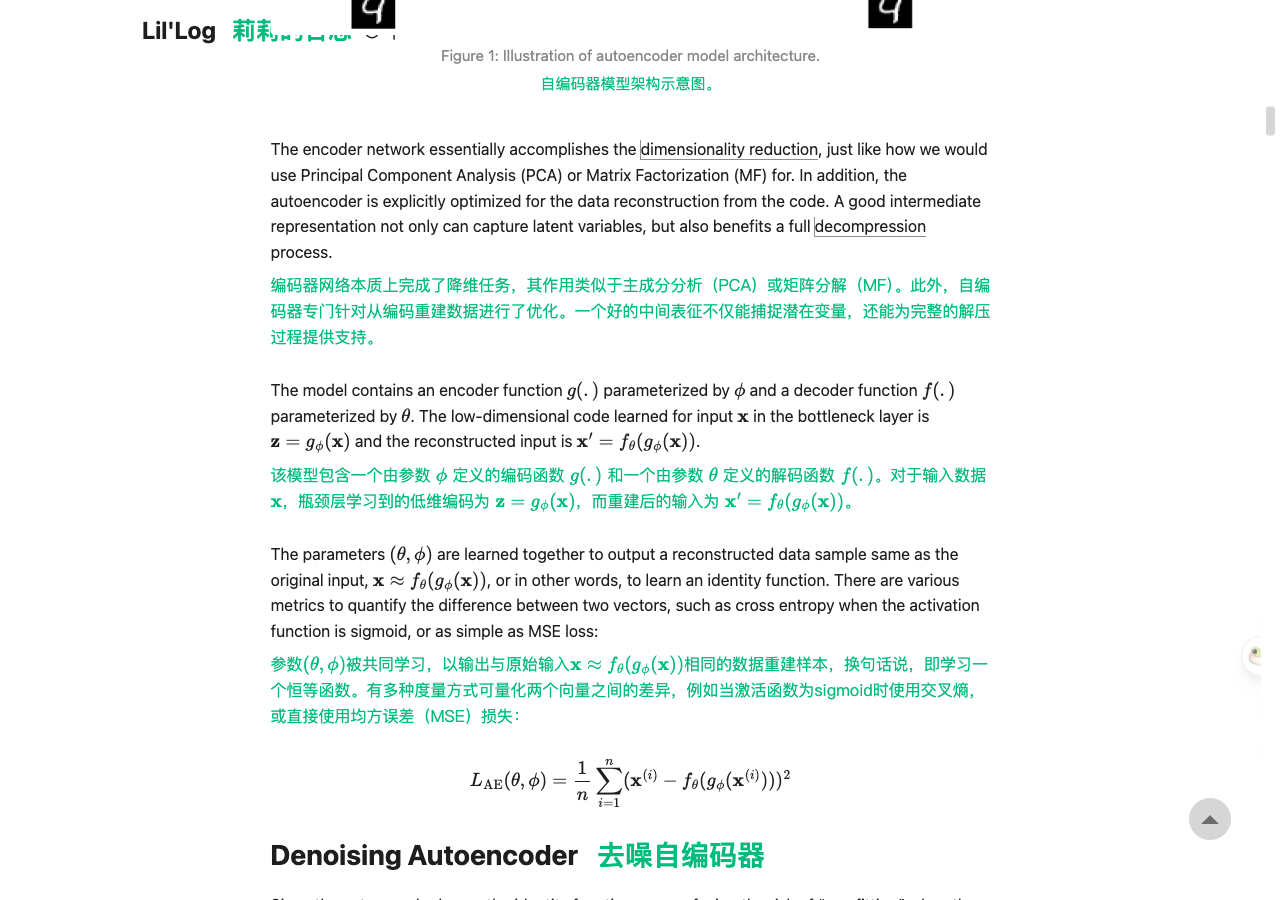
Bilingual reading of Lil’Log’s autoencoder tutorial. The green Simplified Chinese translation retains the encoder and decoder functions, parameters, and reconstruction expressions for comparison with the English above.
In research, a missing symbol matters
Not all mathematics lives in a centered equation. Variable definitions, distributional assumptions, loss functions, and experimental parameters often sit inside ordinary sentences or figure captions.
Here is a simplified illustration:
| Reading state | What you see |
|---|---|
| Original English | We distinguish instantaneous velocity v from average velocity u. |
| Chinese translation without formulas (illustration) | 我们区分瞬时速度和平均速度。 |
| Chinese translation with formulas (illustration) | 我们区分瞬时速度 v 和平均速度 u。 |
The second sentence still reads naturally, but it no longer tells you which symbol represents which velocity in the next equation.
Research reading needs information you can check against the original. A subscript distinguishes samples; a superscript may indicate a power; a Greek letter names a parameter. Keeping that notation in the translation helps you connect an explanation to the expression it describes.
From understanding a method to reproducing a result
Follow definitions without losing your place
A machine learning paper might introduce inputs, a target distribution, predictions, and a loss function in one paragraph. With formulas preserved, you can find each symbol in the translated explanation and follow their relationships without repeatedly returning to the original to recover missing variables.
The same applies to mathematics, physics, and statistics: when prose and notation depend on each other, the translation needs to show both.
Read figure captions with their conditions intact
Captions pack a lot into a few lines: which variables a plot compares, which parameters were used, and under what conditions a result holds.
This fix also covers inline formulas in captions, including formulas nested inside bold text, italics, and links. You can read an explanation alongside its symbols, then check it against the figure.
Cross-check expressions and parameters during reproduction
Reproducing a paper requires more than understanding its main idea. You need to check dimensions, resolution, parameters, and objectives. Dropping the multiplication sign from 256 × 256 changes what you read.
Preserving the original expressions makes the translation more useful alongside the paper, code, and experiment configuration. In bilingual mode, the source stays above the translation, ready for checking key definitions and claims.
What changed
Previously, extracting text for bilingual translation could skip formulas or flatten their typesetting into garbled characters. Switching translation models could not recover content already lost during extraction.
Read Frog now keeps each formula and records its position, translates the surrounding prose, then places the original formula at its corresponding position in the translation. Subscripts, superscripts, fractions, and fonts retain the page's mathematical typesetting.
Built-in support covers common web formats, including native MathML used by arXiv, MathJax, KaTeX, and Wikipedia math. The fix has been verified on arXiv HTML papers, a Flow Matching tutorial, research blogs, and Wikipedia pages. Common formats need no extra configuration.
This update preserves formulas in bilingual webpage translation. On arXiv, open the paper's HTML page. Standalone display equations stay in the original content; this update does not change formula handling inside PDFs.
Occasionally, a translation service may still omit a formula's position marker. Read Frog appends the missing formula to the end of the translation to keep it visible. If you see a formula there, check the original above for its intended position.
Update to 1.46.8 and return to that paper
- Check that your browser has Read Frog 1.46.8 or later.
- Open a webpage with formulas, such as this arXiv HTML paper.
- Start bilingual webpage translation and try reading a variable definition or figure caption.
There is no separate formula switch. Translate as usual and read the explanation in your preferred language alongside the paper's original mathematical expressions.
We want you to spend less time recovering missing symbols and more time on the questions that matter: why an assumption holds, how a derivation works, and whether a result can be reproduced.
If a formula still displays incorrectly, share the page URL, translation provider, and a screenshot through GitHub Issues. For the full details, see PR #2155 and the 1.46.8 release notes.