
Selection Translation
Translate the text you have selected. The result streams into a panel beside the selection, and the page itself is left alone.
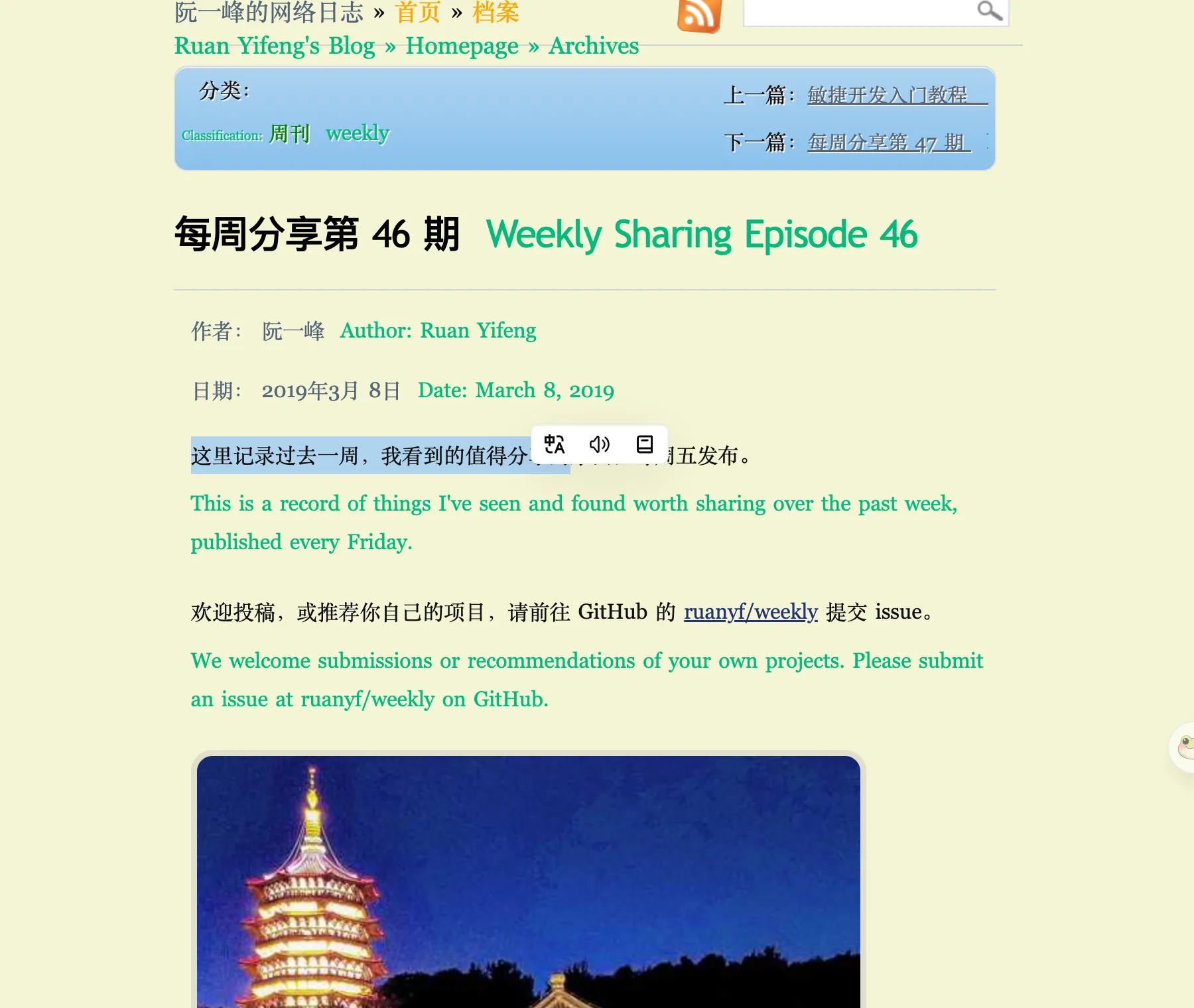
Select some text, and a small toolbar appears next to it. Its Translate button sends that selection off to be translated and opens a panel beside it, where the translation arrives word by word.
Nothing on the page is replaced. This is the reading gesture for a phrase you want to look at closely — a sentence, a quote, a term — not for the article around it.
Three ways in
| How | What it needs |
|---|---|
| The toolbar's Translate button | The toolbar enabled, and the Translate action switched on |
| Alt + T | A selection. Without one you get an error toast instead of an empty panel |
| Right-click → Translate "…" | The context menu entry point switched on |
All three open the same panel and run the same request. The shortcut is ignored while your cursor sits in a text box, so it will not fire as you type; you can change it on the Shortcuts page.
Which buttons the toolbar carries, and where it is allowed to appear at all, are covered in Entry Points.
What the panel gives you
The translation streams in rather than landing all at once, so a long selection starts reading before it has finished. On a reasoning model, the model's thinking is shown above the result while it works.
Above the result sits the text you selected, so you can compare the two without turning back to the page. Under it, once there is something to act on, are a copy button and a speak button that reads the translation aloud with your Text to Speech voice.
The header carries a target-language selector. Changing it retranslates immediately — and it is your real target language, the same one page translation uses, not a setting local to this panel.
The header also has a pin. A pinned panel keeps its position and size, and reuses itself for your next selection instead of reopening somewhere else.
In the footer are three controls: the provider in use, a regenerate button that runs the request again, and a button that shows the page context being sent along — the page title, and the paragraphs the selection sits in.
Which provider runs it
Selection toolbar translation has its own provider assignment, separate from page translation and subtitles. Set it in API Providers, or change it from the panel's footer — that dropdown writes the assignment, so the next selection uses it too.
Both LLM providers and pure translation providers work here. What follows from the choice:
- On an LLM provider, your glossary reaches the request, and so do the prompts you manage under Custom Prompts — the page-translation set, not the subtitle one.
- On a pure translation provider such as Google Translate or DeepL, there is no prompt to carry either of those. See Pure Translation Providers.
AI Smart Context applies either way when it is on: the page title, description, and a summary of the page are offered to the model so a pronoun or a term in your selection can be resolved from what surrounds it. It is configured in Translation Control.
Not the same thing as hover translation
These two are easy to confuse and they work differently.
| Selection translation | Hover translation | |
|---|---|---|
| What it takes | Text you have already selected | The paragraph under your pointer |
| How you start | A button, Alt + T, or the context menu | Holding a key, or press-and-hold the mouse |
| Where it lands | A panel beside the selection | In the page, next to the paragraph |
| Undo | Close the panel | Trigger the same paragraph again |
Press-and-hold belongs to hover translation and to nothing else. Selection translation has no long-press trigger — it needs text you have already selected, so there is nothing for a hold to point at.
Where to go next
The same panel is where note suggestions surface: after an AI translation finishes, Read Frog can offer the words in your selection that are worth keeping.
For the rest of the toolbar — the Dictionary button in the screenshot above, and any action you write yourself — see Custom AI Actions.