
Card Templates
Turn a notebase's fields into a card front and a card back, and watch the result before you save.
A card template is what makes a notebase reviewable. It holds two patterns — Front and Back — and every note in the notebase is rendered through them into one card.
Until a notebase has at least one template it has no cards, and the Review button takes you to the template editor instead of a session.
Create one
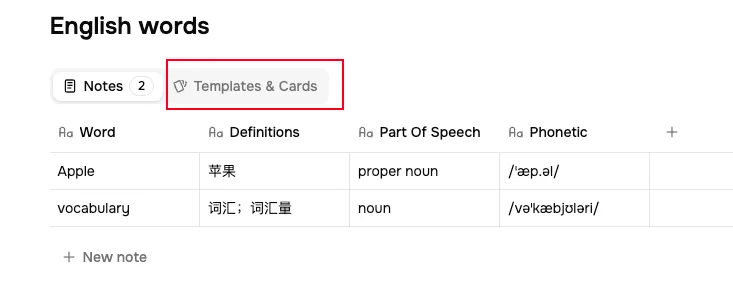
Open Templates & Cards
Open the notebase and switch to the Templates & Cards tab.
Click Add template

Name it
The name is only for you, and it shows on the card during review, so make it say what the card asks: "Term → definition", "Sentence cloze", "Concept → explanation".
Write the front and the back
Each pattern is a small text box with a row of field buttons underneath it. Click a field button to drop that field in at the cursor; type around it freely. Line breaks are kept.
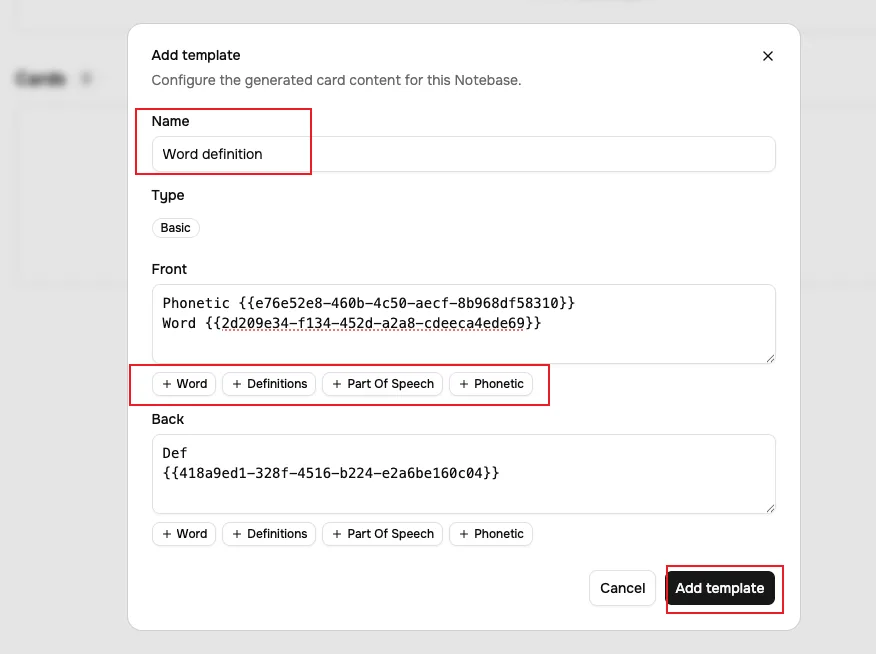
For a vocabulary notebase:
- Front: Term
- Back: Definition, then the example sentence and its translation
For anything else, the same shape holds — put the question on the front and what counts as knowing it on the back.
Check the live preview, then save
The right side renders the card against a real note, with Previous note and Next note to walk through them. With no notes yet, field names stand in as placeholder values and the preview is labelled Sample data.
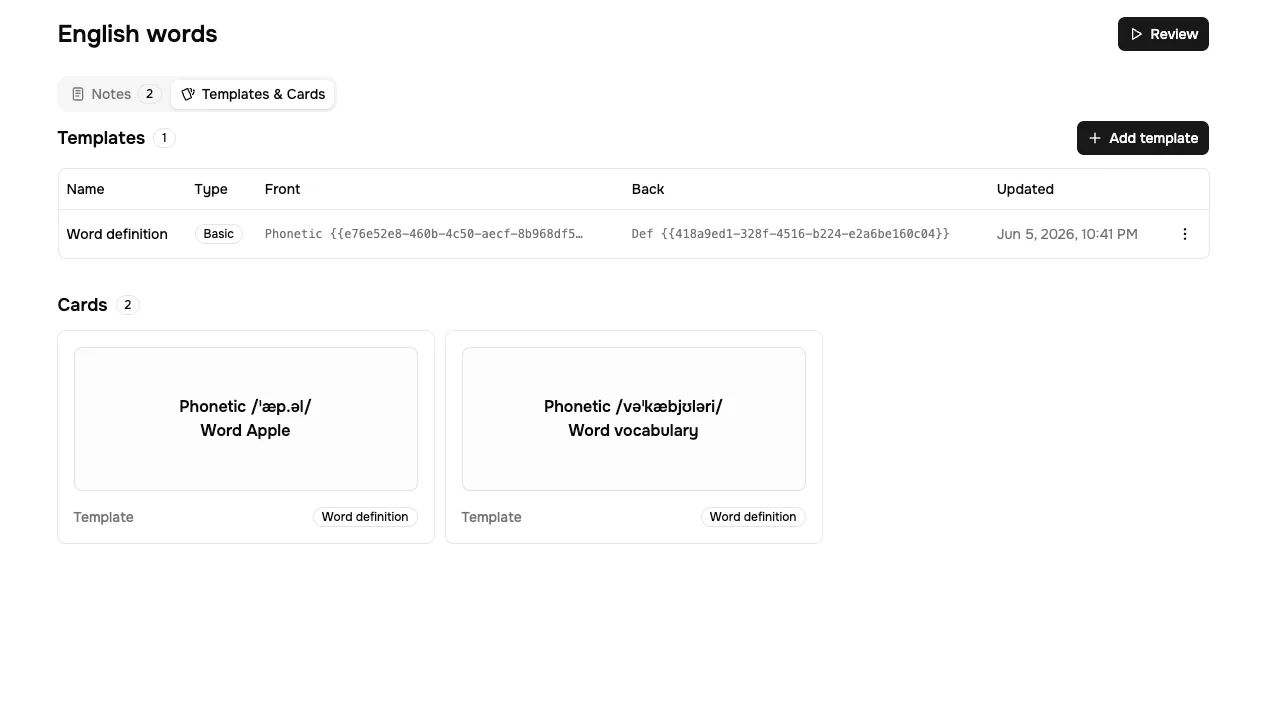
Saving generates a card for every note that already exists. Notes you add later get their card automatically.
What ends up on the card
A field reference is replaced with that note's value at review time — not at save time. Edit a note and its cards show the new text immediately, schedule intact.
An empty cell renders as nothing. That is worth designing around: a back made of three fields where only one is usually filled reads as a mostly blank card. Either keep optional fields out of the template, or give them a label in the pattern so the blank has context.
Put the field you are testing recall of on the front and nothing else. Anything extra on the front — the definition's first word, the difficulty rating — is a hint, and a hint you did not mean to give makes the grade you record less honest.
Several templates on one notebase
Add a second template and every note gets a second card, scheduled independently. This is how you get recognition and production out of one note: term → definition in one template, definition → term in the other.
Cards from the same note do not pile up in one day, though. Review one of them and the note's other cards step aside until tomorrow, so two templates do not double your daily load on the same material.
The Cards section
Below the templates, Cards lists every generated card with the template it came from and its current status — New, Learning, Review, Skipped today or Suspended. A skipped or suspended card can be brought back from here, and View memory opens that card's forgetting curve and review history.
If the list is empty, the notebase has no notes yet, or the card stream is still syncing — give it a moment and refresh.
Deleting a template
Deleting a template deletes the cards it generated, and their review history with them. The notes are untouched. If you recreate the template, its cards start from new.
A field that a template references cannot be deleted while the reference exists. Remove the field from the front and the back first, then delete the field.
Where to go next
The Review Session — what the card looks like once you start reviewing it.